


For decades, custom home building focused on two primary metrics: aesthetics and utility. We asked, "How does it look?" and "How does it function?" However, as we move through 2026, a third, more vital metric has taken center stage: health and wellness architecture.
At Elkridge Custom Homes, we recognize that a home is more than a shelter—it is a physiological environment. Emerging research in neuroarchitecture (the study of how the built environment affects the brain) proves that your home’s layout can either be a source of chronic stress or a powerful tool for mental restoration.
Designing for the future means building homes that act as "preventative medicine." This guide explores the scientific link between spatial design and mental health, and how you can optimize your layout for a lifetime of well-being.
The Science of Wellness Architecture
In 2026, Elkridge Custom Homes defines home value through Wellness Architecture—designing spaces that act as "preventative medicine" for your mental health.
The Essentials
- Neuroarchitecture: Layouts impact your nervous system. "Prospect" (views) and "Refuge" (cozy nooks) balance safety with inspiration, reducing chronic cortisol levels.
- Circadian Lighting: Eastern-facing "active zones" boost morning serotonin, while tunable evening light prepares the brain for sleep.
- Biophilic Flow: Visual access to nature and "fractal" textures (wood/stone) lowers heart rates and recharges cognitive focus.
- Acoustic Zoning: Creating "buffer zones" to eliminate background noise and prevent "acoustic stress" in open-plan living.
- Net-Positive Health: Future-proof homes use AI and non-toxic materials to ensure occupants don't just reside, but thrive.
What is Wellness Architecture?
Wellness Architecture is a design discipline that goes beyond basic sustainability. While green building focuses on the health of the planet, wellness architecture focuses on the health of the human. It uses psychological and physiological data to create buildings that proactively support the mental and physical vitality of their occupants.
By integrating principles of sustainable design, such as non-toxic materials and natural lighting, this approach ensures that the "indoor generation"—those who spend 90% of their time inside—can thrive rather than simply reside.
The Biological Connection: How Layouts Impact the Brain
To understand why a home layout matters, we must look at how the brain processes space. Our ancestral instincts are still very much active; our brains are constantly scanning our surroundings for safety and comfort.
Neuroarchitecture and the "Threat Assessment"
When you walk into a room, your brain instantly performs a "threat assessment," checking for safety, comfort, and sensory overload.
- Proportion and Cortisol: Research shows that cramped, dark, or cluttered layouts trigger the release of cortisol (the stress hormone). Persistent exposure to "tight" spaces can keep the nervous system in a state of low-level "fight or flight."
- The "Prospect and Refuge" Theory: Humans have an evolutionary preference for layouts that offer "prospect" (wide, open views) and "refuge" (protected, cozy corners). A high-performance green architecture layout balances open-plan social areas with private, enclosed nooks.
Core Pillars of Mental Health-Focused Design
Transitioning from theory to practice, Elkridge Custom Homes utilizes several scientific pillars to ensure your custom layout supports your cognitive and emotional state.
1. Circadian Lighting: Syncing with Your Biological Clock
Light is the most powerful regulator of our biological clock. A poorly lit home can lead to "social jetlag," characterized by fatigue and irritability.
- Morning Serotonin Boost: Exposure to blue-spectrum light (natural morning sun) suppresses melatonin and boosts serotonin. A wellness-focused layout places high-activity zones, like the kitchen, on the eastern side of the house.
- Warmth in the Evening: Conversely, evening spaces should utilize "tunable" warm lighting to signal the brain to begin the wind-down process.
2. Biophilic Layouts: Nature as a Mental Filter
Biophilic design is more than just adding plants; it is the intentional integration of nature into the built environment to reduce cognitive load.
- Visual Access: Studies indicate that looking at greenery for just 40 seconds can significantly boost concentration and lower heart rates.
- Fractal Patterns: The brain is wired to process the irregular, repeating patterns found in nature (fractals). Using sustainable materials like wood and stone allows the mind to "recharge" effortlessly.
3. Acoustic Wellness and "Quiet Zoning"
In an age of open-plan living, "acoustic stress" has become a silent epidemic. Constant background noise can lead to irritability and mental fatigue.
- Functional Zoning: We use "buffer zones"—like hallways or libraries—to physically separate loud social areas from quiet restorative spaces.
- Sound Dampening: Utilizing eco-friendly architecture design features like sound-absorbing cork or acoustic fabrics ensures "auditory privacy."
The Economic and Psychological Benefits
|
Benefit |
Impact on the Occupant |
|
Stress Reduction |
Lower cortisol levels and decreased heart rate due to optimized spatial flow. |
|
Cognitive Boost |
Enhanced creativity and focus through "circadian-aware" lighting and high ceilings. |
|
Longevity |
Better sleep cycles and respiratory health via non-toxic, green building materials. |
|
Resale Value |
Higher market demand for homes certified in wellness and sustainable architecture. |
The Future of Wellness: AI and Neuro-Mapping
As we look toward 2030, wellness architecture is becoming increasingly predictive. At Elkridge Custom Homes, we are exploring how AI can run thousands of simulations to find the exact layout that maximizes your "happiness score" based on light, sound, and air quality.
The next generation of green buildings will not only be "Net-Zero" in energy but "Net-Positive" in human health, utilizing biomimicry to create environments that feel more like nature and less like machines.
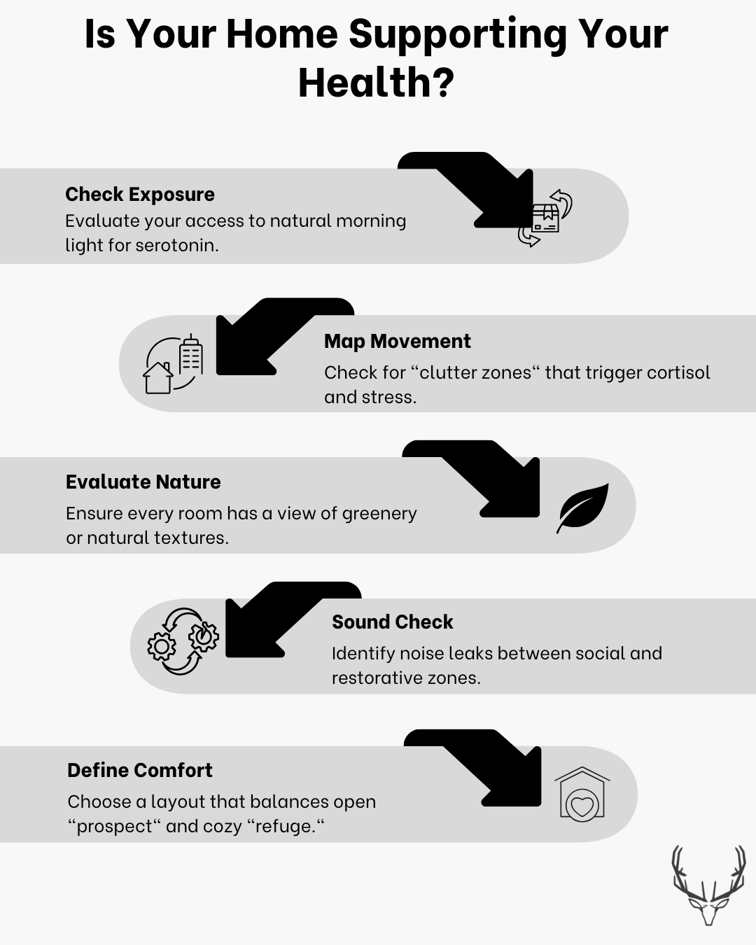
Knowing science is the first step; applying it is the second. Is your current environment working for or against your nervous system? Use our Wellness Design Audit below to evaluate your home’s impact on your mental health. If your layout is failing the test, it may be time to engineer a space that proactively supports your peace of mind.
Why Choose Elkridge Custom Homes?
At Elkridge Custom Homes, we bridge the gap between luxury and psychological well-being. Our team specializes in translating complex green architecture principles into beautiful, livable sanctuaries. We don't just build walls; we engineer peace of mind.
Learn more about our team and our commitment to environmental and human excellence in every project.
Frequently Asked Questions (FAQ)
What is wellness architecture?
Wellness architecture is a design discipline that uses physiological and psychological data to create buildings that proactively support the mental and physical health of occupants, prioritizing the intersection of human biology and the built environment.
What are the 7 pillars of wellness?
Based on the WELL Building Standard, these pillars- Air, Water, Nourishment, Light, Fitness, Comfort, and Mind serve as evidence-based guidelines for engineers and architects to optimize human health through specific building design choices.
What are the 3 C's of architecture?
The 3 C's—Context, Continuity, and Communication- ensure buildings harmonize with their surrounding environment, maintain logical spatial flow, and intuitively convey their intended purpose to users, resulting in cohesive, functional experiences.
What is the highest-paid architecture specialty?
Sustainability, healthcare, and wellness architecture currently command the highest salaries. These roles require complex technical knowledge in high-performance systems, neuroaesthetics, and stringent indoor environmental standards, making them highly sought-after, specialized fields.
How does home layout affect anxiety?
Cluttered, dark, or closed-off layouts can trigger the brain's "threat detection" system, causing stress. Conversely, optimized "spatial flow" emphasizing natural light and clear, open sightlines promotes relaxation by effectively calming the nervous system.
Final Thoughts
Architecture is no longer just about wood, stone, and glass it’s about heart rate, hormone levels, and peace of mind. By prioritizing eco-friendly architecture design, you are making a mental investment that will pay dividends for decades.
Ready to design your sanctuary? Contact Elkridge Custom Homes today to bring your vision of wellness to life.
How would you describe the "feeling" of your current home does it offer more "prospect" or "refuge"?