



Renovating usually costs less when a house is structurally sound, and the existing layout meets your needs. However, when a renovation requires major structural repairs, new systems, and a completely different floor plan, the cost difference can narrow. In these situations, tearing down the house and rebuilding may offer better long-term value.
For homeowners in Colorado Springs, the decision involves more than comparing construction estimates. Demolition requirements, soil conditions, temporary housing, and the cost of bringing an older home up to modern standards can all affect the budget. Understanding these factors helps you compare both options fairly before committing to a project.
Key Takeaways
- Renovation is generally more affordable when the home's structure is sound, and the layout works.
- When a major renovation estimate reaches roughly 50% to 60% of the cost of rebuilding, it may be worth pricing a new build.
- Demolition is only one part of the rebuilding budget. Excavation, foundation work, utilities, and temporary housing can have a greater impact on the total cost.
- Comparing both options against the same finished-home requirements provides a more accurate financial picture.
- Local permits, demolition notifications, and site conditions should be considered before making a final decision.
Is It Cheaper to Tear Down a House and Rebuild or Renovate?
Neither option is automatically cheaper. The right choice depends on the home's current condition, the changes you want to make, and how much of the existing structure can be retained.
A renovation generally costs less because it preserves usable parts of the house, such as the foundation, framing, and roof. A rebuild replaces the existing structure and allows you to design a home around your current needs.
A smaller renovation that updates finishes, improves a kitchen, or refreshes a bathroom will usually cost less than rebuilding. However, a whole-house renovation involving electrical wiring, plumbing, heating and cooling systems, windows, roofing, and major layout changes can become significantly more expensive.
A common builder rule of thumb is to investigate rebuilding when a comprehensive renovation estimate reaches approximately 50% to 60% of the cost of a new build. This is a starting point for comparison, not a universal financial rule. The condition of the property and the scope of both projects still matter.
Compare the Same Finished House, Not Two Different Projects
One of the biggest mistakes homeowners make is comparing the cost of renovating their current home with the cost of building their ideal home. These projects may deliver very different results.
For example, a renovation might preserve low ceilings, small windows, and a cramped floor plan. A rebuild could provide the additional bedrooms, improved insulation, larger windows, and open living areas the homeowner actually wants.
Create a List of Your Requirements
Before requesting estimates, document what the finished home should include:
- Total square footage and number of bedrooms and bathrooms.
- Ceiling heights and preferred room layouts.
- Garage size and storage requirements.
- Window sizes, natural light, and views.
- Insulation, energy efficiency, and overall building performance.
- Kitchen, bathroom, and other interior requirements.
Ask contractors to price both options against this list. If the renovation cannot deliver a particular feature, include the cost of addressing that limitation or acknowledge the difference in the comparison.
This approach helps you determine whether renovation genuinely costs less or simply provides a smaller scope of work.
What Does It Cost to Tear Down and Rebuild a House in Colorado Springs?
The cost of rebuilding depends on the home's size, design, finishes, site conditions, and construction requirements. Demolition is one expense, but it is only a small part of the overall budget for many custom homes.
Elk Ridge Custom Homes reports that its homes generally fall within the $1.5 million to $3 million-plus range, depending on the project. National demolition estimates published in 2024 commonly ranged from approximately $3,000 to $25,000, with an average around $18,000. These are broad reference figures rather than current Colorado Springs quotes, so homeowners should obtain local estimates.
Factors That Can Increase Rebuilding Costs
Soil and foundation conditions: Colorado properties can have rocky ground or expansive soil. Excavation may uncover conditions that affect foundation design and construction costs. These expenses should be discussed during the estimating process. Learn more about homes built for extreme weather when considering durability and building performance.
Utilities and existing services: Determine whether existing utility connections can be reused or whether upgrades are required. Properties with wells or septic systems may need additional assessment.
Temporary housing: A rebuild requires the household to move out during construction. Rent, storage, moving expenses, and other temporary living costs should be included in the budget.
Design and finishes: Custom layouts, premium materials, large windows, and specialized features can increase the cost of a new home. Compare these choices with the equivalent requirements for the renovation.
How Long Does Rebuilding Take?
Elk Ridge's published design-build process indicates approximately two to three months for design and estimation, followed by eight to twelve months of construction. The overall period from the first meeting to move-in is typically around twelve to fourteen months.
Actual timelines depend on permitting, design decisions, contractor schedules, weather, site conditions, and material availability. Homeowners should plan temporary accommodation and associated costs accordingly.
What Demolition Requirements Should Colorado Homeowners Know?
Demolishing a house in Colorado involves more than arranging for equipment and debris removal. Homeowners must account for applicable state requirements and local permitting before work begins.
Asbestos Notifications and Removal
The Colorado Department of Public Health and Environment has demolition notification requirements that include a ten-working-day waiting period before demolition can begin. Requirements can apply even when asbestos is not identified. If asbestos-containing materials are present, additional inspection and abatement requirements may apply.
Older properties should be assessed early so that testing, notifications, and any necessary removal work can be incorporated into the schedule.
What Hidden Costs Can Renovations Reveal?
Renovations also come with uncertainties. Some problems only become visible after walls, ceilings, or floors are opened. Older homes may need repairs or upgrades that were not apparent during the initial assessment.
For homes built before 1978, contractors disturbing painted surfaces may need to follow the Environmental Protection Agency's lead-safe renovation work practices. These requirements can affect the project's cost, preparation, and schedule.
Working within an existing structure can also limit design possibilities. Moving walls, raising ceilings, changing window sizes, or reconfiguring rooms may require extensive structural work. Homeowners who want to fix a dated interior without a full remodel may find that targeted design changes are more practical than a complete renovation.
Renovation vs. Rebuild: Cost Comparison
|
Cost area |
Whole-house renovation |
Tear down and rebuild |
|
Foundation and structure |
Retained if sound; repaired if needed |
New foundation and structure |
|
Electrical, plumbing, and HVAC |
Existing systems may need replacement |
New systems designed for the home |
|
Insulation and building envelope |
Limited by existing construction unless extensively modified |
Designed around the new home's requirements |
|
Demolition |
Selective demolition; hidden materials may require special handling |
Full demolition, notification, and applicable permits |
|
Permits and building codes |
Requirements depend on the work and applicable codes |
New-construction requirements apply |
|
Temporary housing |
Depends on the extent and duration of the work |
Budget for the construction period, often several months |
The table provides a general comparison. Actual costs depend on the home's condition, project specifications, and local requirements.
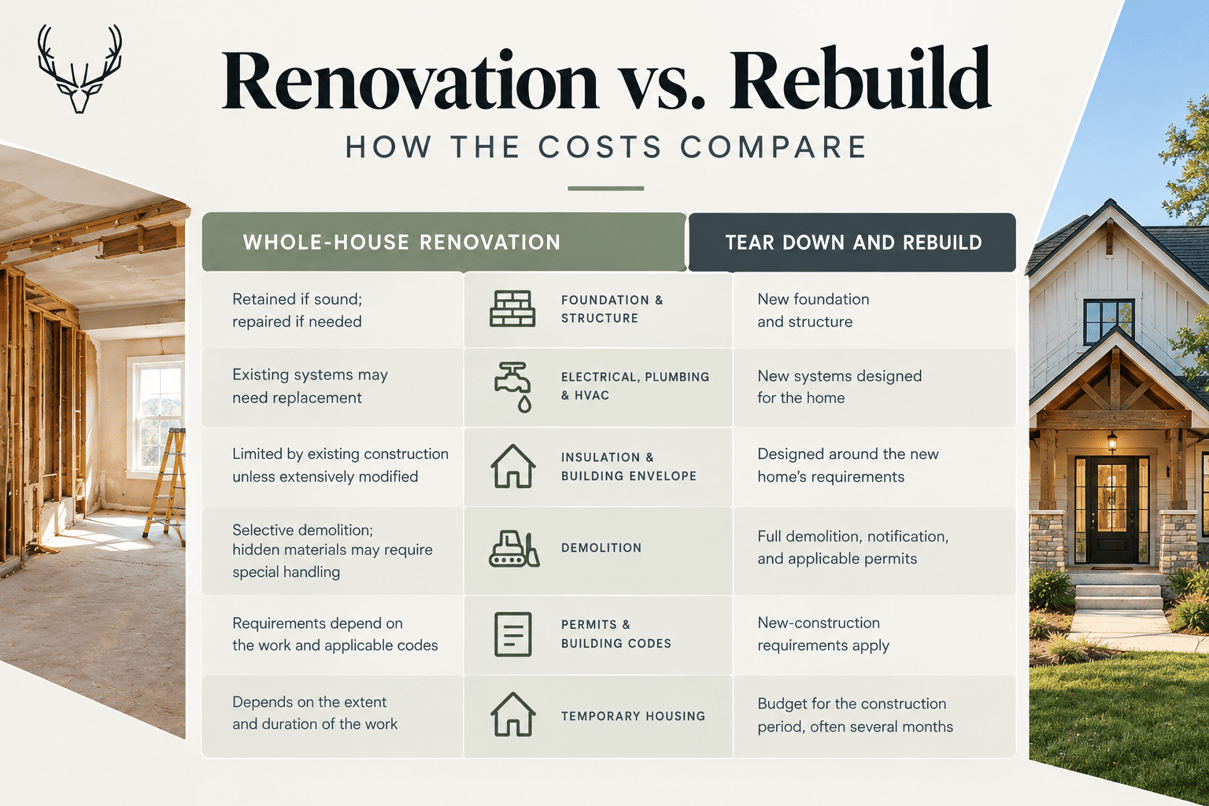
While comparing renovation and rebuilding costs helps you understand the upfront investment, the decision also depends on what you may recover if you sell the property in the future. Looking at potential resale value alongside your budget, long-term needs, and plans for the home can help you decide which option makes more financial sense.
Should Resale Value Determine Your Decision?
Resale value is worth considering, but it should not be the only factor. Remodeling and rebuilding projects do not necessarily return their full costs when a property is sold.
Industry research, including the Cost vs. Value report, compares remodeling costs with estimated resale value. However, these figures do not measure every benefit a homeowner receives from living in a more functional, comfortable, or energy-efficient house.
Consider how long you intend to stay, whether the home meets your needs, and how much value the improvements provide to your everyday life.
How to Decide Between Renovating and Rebuilding
The best option becomes clearer when you consider the structure, layout, location, and total project cost together.
When Rebuilding May Make More Sense
Consider obtaining a rebuild estimate if:
- The foundation or framing has significant problems.
- You need to relocate most interior walls or add a story that the existing structure cannot support economically.
- Major electrical, plumbing, and HVAC systems need replacement.
- You want to remain on the property, but the existing house no longer meets your needs.
- The improvements required to achieve your preferred insulation and building performance would be extensive.
These conditions do not automatically mean rebuilding is the better option. They indicate that a full comparison may be worthwhile.
When Renovation May Be the Better Choice
Renovation may be more practical if:
- The foundation and framing are in good condition.
- The existing floor plan mostly meets your needs.
- You can achieve your goals without replacing most of the home's major systems.
- Mature trees, site constraints, setbacks, or existing property characteristics make a rebuild less practical.
- Your budget and timeline favor completing the work in stages.
A professional assessment can help determine which existing features are worth preserving and which changes would require significant investment.
How to Get a Reliable Cost Comparison Before Committing
Homeowners do not have to base this decision on rough estimates alone. The next step is to obtain detailed costs for both options using the same project requirements.
Elk Ridge Custom Homes offers a Design and Estimation phase that typically takes two to three months and costs approximately $30,000 to $40,000, depending on the home. According to the company's published process, homeowners receive plans, engineering, selections, and a fixed price based on subcontractor bids. The plans remain theirs whether or not they proceed with construction through Elk Ridge.
This process provides a more concrete basis for comparing a potential rebuild with a renovation estimate. Homeowners can evaluate the costs, scope, and expected outcome of each option before deciding how to proceed. It also helps identify design challenges before they get expensive.
For homeowners who love their Colorado Springs location but are unhappy with their existing house, a tear-down and rebuild may be worth exploring. If the numbers or site conditions do not support that approach, renovation may remain the more sensible choice. Homeowners who already own a property can also explore options for checking a lot's buildability before deciding how to proceed.
Frequently Asked Questions
1. Is it cheaper to tear down a house and rebuild or renovate it?
Renovating is generally cheaper when the existing structure is sound, and the layout meets your needs. Rebuilding may become more competitive when extensive structural repairs, system replacements, and layout changes are required. Compare both options using the same finished-home specifications before deciding.
2. How do you know when it is better to rebuild instead of renovate?
Rebuilding may be worth considering when the foundation or framing has significant problems, most major systems need replacement, or the existing layout cannot meet your needs without extensive structural work. A professional assessment and comparable estimates can help you evaluate the options.
3. How much does it cost to tear down and rebuild a house in Colorado Springs?
The total cost depends on the home's size, design, materials, site conditions, demolition, and permitting requirements. Elk Ridge Custom Homes reports that its homes generally range from $1.5 million to $3 million-plus. Request a project-specific estimate rather than relying on national averages.
4. What hidden costs should homeowners consider when comparing renovation and rebuilding?
Renovations can uncover structural damage, outdated wiring, plumbing problems, asbestos, or lead-related requirements. Rebuilding can involve unexpected excavation and foundation costs, utility upgrades, demolition expenses, and temporary housing. Include these possibilities when comparing the total budgets.
5. Do you need a permit to tear down a house in Colorado Springs?
Demolition generally requires compliance with applicable state notification requirements and local permitting rules. Colorado also has demolition notification requirements involving a ten-working-day waiting period.