


What comes standard in an Elk Ridge home
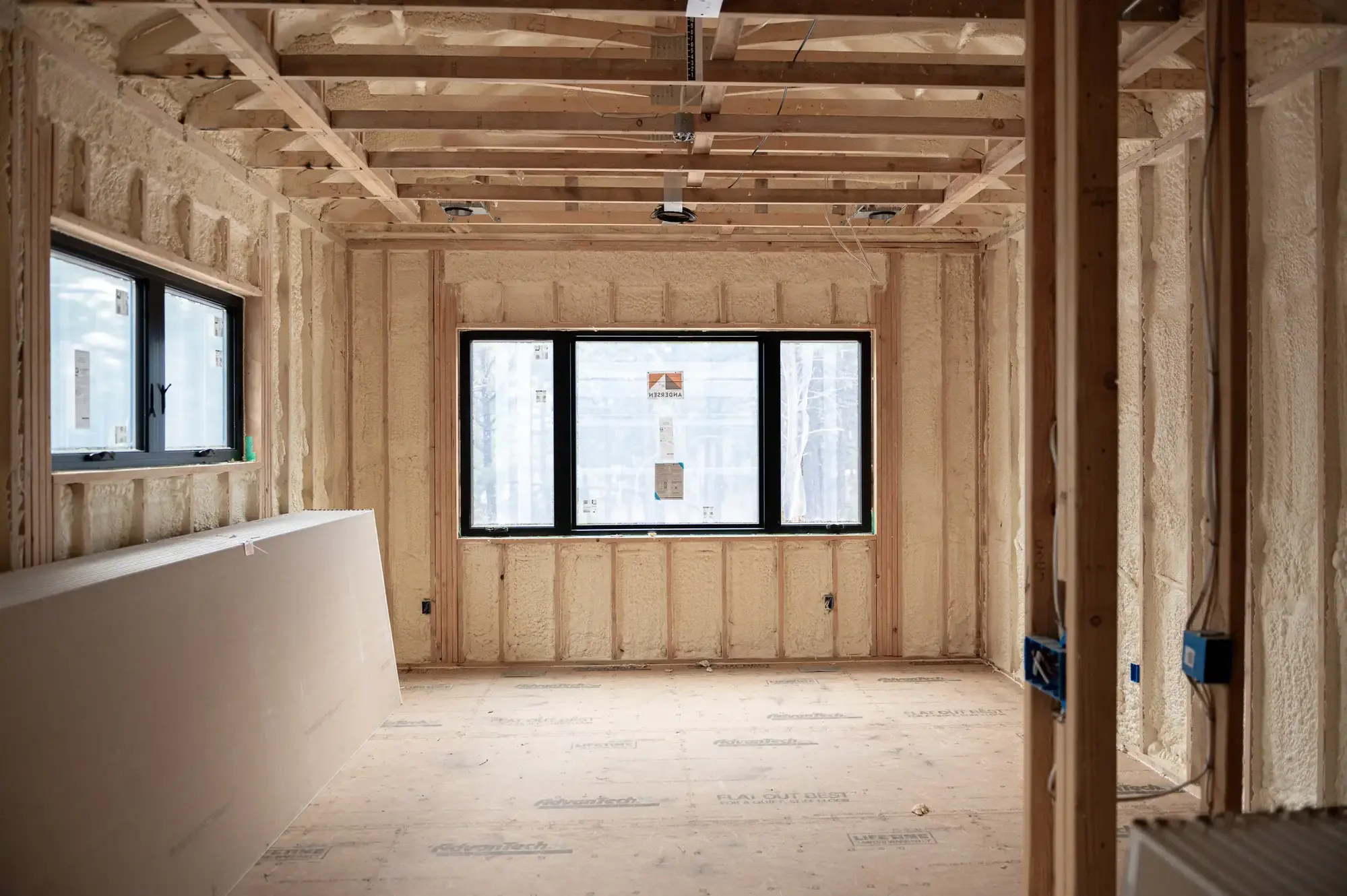
Every custom home we build in Colorado Springs, Monument and Black Forest includes closed-cell spray foam insulation, solid wood trim and doors, 4000 PSI rebar-reinforced concrete, real stone veneer, hand-troweled drywall, 10-foot main-level ceilings and commercial-grade appliances. Most builders call these upgrades. For us, they're the starting point.
Phil and Jason started Elk Ridge in 2003 as fine-finish craftsmen. We've spent a lot of time behind the drywall of other people's houses, and we know which shortcuts show up five years later as squeaky floors, drafty rooms and chipped trim. So we stopped offering the shortcuts.
Here's the full list, what you'd often find instead, and what it means once you're living in the house.
|
Area |
Elk Ridge standard |
Common elsewhere |
What you notice living there |
|
Insulation |
100% closed-cell spray foam |
Fiberglass batts in walls, blown-in fiberglass in roof. |
Quiet on a 60 mph Front Range wind day, no drafts, lower heating bills |
|
Trim and doors |
Solid wood trim and solid doors |
MDF trim, hollow-core doors |
Trim doesn't swell in a humid bathroom or chip when the vacuum hits it; doors close with a solid sound |
|
Concrete |
4000 PSI, rebar-reinforced throughout |
Lower-strength mixes, rebar only where code requires |
Fewer cracks, slabs that stay put, flatter floors |
|
Floor system |
Oversized floor systems with engineered trusses and AdvanTech subfloor |
Standard I-joists, OSB subfloor |
Floors feel solid, with fewer squeaks and less bounce, mechanical systems fit within the trusses so no drops (soffits) |
|
Ceilings |
10 ft basement, 10 ft or more on the main level, 9 ft or more upstairs |
8 to 9 ft |
Rooms feel larger than the square footage, basements don't feel like a basement |
|
Drywall |
Hand-troweled finish |
Standard spray texture |
A smoother, more refined wall finish that is easy to patch and touch-up |
|
Exterior |
Real stone veneer, acrylic stucco over lath with fiberglass mesh |
Manufactured stone, thinner stucco systems with control joints |
Real stone looks better and is stronger, fiberglass mesh makes stronger walls that don't need control joints, acrylic stucco looks better and lasts longer |
|
Roof edges |
10 inch fascia, 6 inch gutters |
6 to 8 inch fascia, 5 inch gutters |
Handles spring downpours and looks proportional on a large home |
|
Paint |
Sherwin-Williams Emerald |
Builder-grade paint |
Holds color and washes clean longer, sheens look and feel high-end |
|
Garage |
30 ft deep, with 8 or 9 ft doors. |
Standard depth, 7 ft doors |
Your lifted truck fits, with room to walk around it |
|
Windows |
Andersen, Pella, Marvin, or European tilt-turn |
Builder-grade vinyl |
Energy efficient, quiet, UV protected, lasts longer, less maintenance |
|
Appliances |
Commercial-grade, from brands like Wolf, Sub-Zero and La Cornue |
Residential-grade appliance packages |
A kitchen built for people who actually cook, cabinet panel covered for less stainless to keep clean |
Why this matters in Colorado
The Front Range is hard on houses. We get high winds, big temperature swings in a single day, intense sun at elevation, hail and freeze-thaw winters. Most of our standards come straight from that reality. Spray foam stops the wind from finding its way through the walls. Stronger concrete and heavier floor systems handle expansive soils and settling. Real stone and a quality stucco system hold up to hail and UV that wear out cheaper materials.
Why it costs more, and why it's worth it
These standards do add cost up front, and we won't pretend otherwise. But they're the parts of a house that are hardest or impossible to fix later. You can swap a light fixture in an afternoon. You can't add spray foam to finished walls or pour a new foundation. We'd rather spend your money where it counts for the next 30 years.
It also means comparing builders is easier than it looks. When you get another builder's price, ask what it would cost with spray foam, solid wood trim, 4000 PSI concrete, real stone and commercial appliances. That's the honest comparison. Our cost guide walks through the rest.
See it in person
The best way to understand these standards is to stand in one of our homes on a windy day. If you'd like to walk through a recent build, let's set up a time.
FAQ
Is closed-cell spray foam worth it in Colorado Springs?
For most homes along the Front Range, yes. Closed-cell spray foam seals the walls against the high winds and big temperature swings we get here, so the house stays quiet and draft-free and costs less to heat. It also adds rigidity to the walls. Every Elk Ridge home gets 100% closed-cell spray foam as standard.
Why solid wood trim instead of MDF?
MDF is cheaper and paints well on day one, but it swells when it gets wet and dents and chips easily. Solid wood holds its shape in bathrooms and mudrooms and takes years of vacuums, kids and dogs. It's standard in every home we build.
What strength concrete should a custom home use?
We use 4000 PSI rebar-reinforced concrete throughout every home. Higher-strength concrete with full reinforcement resists cracking and movement, which matters on the expansive soils common around Colorado Springs.
Are these standards included in the price or extra?
Included. Everything on this page is part of our standard build, so it's already in the fixed price you get at the end of the design phase.
Can I upgrade beyond these standards?
Yes. These are the floor, not the ceiling. Many of our clients add things like in-floor radiant heating, solar, whole-home automation, triple-pane windows. We'll show you the cost of each option during design.
Do you use the same standards on every home?
Yes. Whether it's a $1.5 million home or one well past $3 million, the parts behind the walls are the same.
Ready to talk about the features you are most excited to have in your home?
The first step is a 30-minute conversation. Bring your questions, your land, or just an idea. We'll tell you honestly whether we're the right builder for your project.
Where We Build
We Build Luxury Custom Homes in Colorado Springs, Monument, Black Forest & Surrounding Areas
Don't Know if We Build in Your Location? Contact Us by Clicking the Button Below.