



Working from home has changed how people think about productivity. Your desk, chair, lighting, and screen setup all affect how well you work. But another space can quietly influence your focus: the place where you pause, stretch, breathe, or reset during the day.
That is where a wellness room can help.
A wellness room at home is not just a stylish corner or a spare room with a yoga mat. It is a dedicated space that supports recovery, calm, and better focus. It can help you step away from work for a few minutes and return with more energy.
But when the space is poorly planned, it can have the opposite effect. A cluttered, uncomfortable, poorly lit, or screen-filled wellness room can make breaks feel less useful. Instead of helping you reset, it may leave you feeling distracted, tired, or mentally stuck.
A wellness room can hurt productivity when it has poor lighting, weak airflow, clutter, uncomfortable furniture, too many screens, or no clear routine. These problems make it harder to relax properly and return to work with focus.
Core Takeaways
- Lighting affects energy. A dark or harshly lit wellness room can make you feel tired, strained, or overstimulated.
- Air quality affects focus. Poor ventilation can make the space feel heavy, especially during long work-from-home days.
- Clutter creates mental friction. A wellness space filled with random items makes it harder to relax.
- Comfort supports consistency. If the room feels uncomfortable, you will not use it regularly.
- Boundaries make the room useful. Without a clear role, a wellness room can turn into another unused or cluttered space.
What Is a Wellness Room at Home?
A wellness room at home is a dedicated space for mental and physical reset. It can be used for meditation, stretching, journaling, reading, prayer, breathing exercises, or quiet breaks.
It does not need to be large or expensive. Even a clean, calm corner can work if it is arranged with purpose.
A home wellness room may include a chair, floor cushion, yoga mat, soft lighting, plants, natural textures, a journal, or a book. The goal is not decoration. The goal is to create a space that helps you step away from work and return with better focus.
How Does a Wellness Room Improve Productivity?
A wellness room improves productivity by giving your mind and body a clear place to reset. When you work from home, it is easy to stay mentally attached to tasks, emails, and deadlines even during breaks.
A well-planned wellness room creates separation between work and recovery. It helps you pause, reduce stress, and return to work with better focus. But if the space is cluttered, uncomfortable, poorly lit, or distracting, breaks can be less effective. That is why lighting, airflow, furniture, layout, and routine all play an important role.
1. Poor Lighting That Drains Your Energy
Lighting is one of the most common wellness room mistakes. A room may look calm but still feel dull, gloomy, or visually harsh.
If your wellness room has very little natural light, it may make you feel sleepy during the day. If it relies only on bright overhead lighting, it may feel too sharp for rest or reflection. Both can reduce the quality of your breaks.
Poor lighting can also cause eye strain, especially when you move from a screen-heavy work setup into another poorly lit space. Instead of feeling refreshed, you may leave the room feeling just as tired.
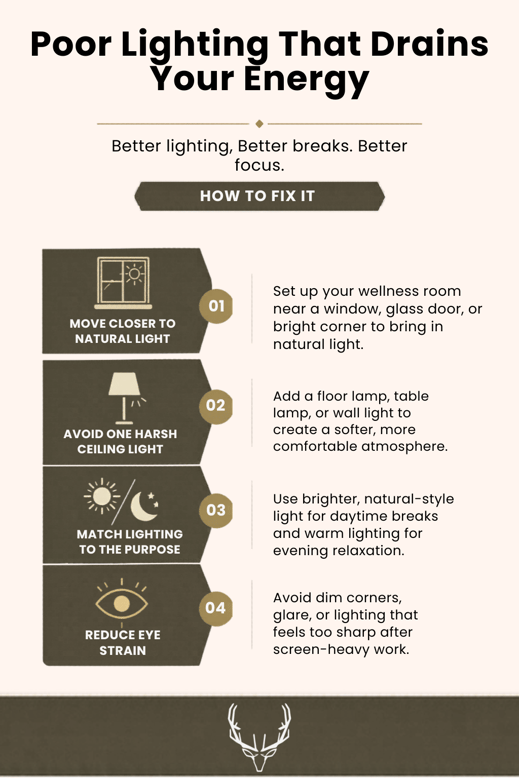
How to Fix It
Use this quick lighting check:
- Move closer to natural light: Set up the room near a window, glass door, or bright corner if possible.
- Avoid one harsh ceiling light: Add a floor lamp, table lamp, or wall light to soften the room.
- Match lighting to the purpose: Use brighter light for daytime breaks and warm lighting for evening relaxation.
- Reduce eye strain: Avoid dim corners, glare, or lighting that feels too sharp after screen-heavy work.
A wellness room should feel calm, but not dull. The goal is to create lighting that helps you reset without making you feel sleepy.
2. Poor Airflow That Makes the Room Feel Heavy
Air quality has a direct effect on how comfortable a room feels. If a wellness room has poor airflow, it can quickly feel stale, warm, or stuffy.
This often happens in spare rooms, basements, closed corners, or rooms that are rarely opened during the day. Even if the space looks peaceful, poor ventilation can make it harder to feel calm and alert.
A wellness room should not feel like a closed box. If the air feels heavy, you are less likely to use the space for breathing exercises, stretching, or quiet breaks.
How to Fix It
Make the room feel breathable with a few simple changes:
- Open the window daily: Even five minutes can improve the feel of the room.
- Keep the door open between uses: This helps air move if the room has no window.
- Use a fan or air purifier: Choose this if the room often feels warm, stale, or closed off.
- Skip heavy scents: Strong candles, sprays, or diffusers can make the space feel uncomfortable.
The room should feel clean, light, and easy to sit in. If the air feels heavy, the space will not support focus or recovery.
3. Using the Wellness Room as a Storage Space
A wellness room loses its purpose when it becomes a storage area. This usually happens slowly. First, one box goes in the corner. Then laundry, extra furniture, files, décor, or unused household items start filling the space.
The problem is not just visual. Clutter creates mental pressure. It reminds you of unfinished chores and pulls your attention away from rest.
If the room holds too many unrelated items, your mind does not treat it as a wellness space. It treats it as another task zone.
How to Fix It
Use this “keep or remove” rule:
|
Keep in the Room |
Remove from the Room |
|
Yoga mat |
Laundry |
|
Reading chair |
Work files |
|
Journal |
Storage boxes |
|
Small plant |
Extra furniture |
|
Soft lighting |
Random household items |
Also, follow these simple steps:
- Clear visible clutter first: Start with the floor, corners, and surfaces.
- Keep only purpose-driven items: Every item should support rest, reflection, stretching, or breathing.
- Use closed storage if needed: Hidden storage is better than open shelves filled with unrelated items.
- Do a weekly reset: Spend five minutes putting the room back in order.
A wellness room should not remind you of chores. If it does, your mind will treat it like another task zone.
4. Choosing Furniture That Looks Good but Feels Bad
Many wellness room ideas focus too much on appearance. The chair looks stylish. The rug matches the room. The floor cushion looks peaceful. But when you actually use the space, it feels uncomfortable.
That is a productivity issue because discomfort shortens your breaks. If your back hurts, your legs feel unsupported, or the floor is too hard, you will avoid the room.
A wellness room should support the body, not just the look of the home.
How to Fix It
Choose furniture by function first:
- For reading: Use a chair with proper back support.
- For meditation: Use a cushion that supports your hips and spine.
- For stretching: Use a mat with enough grip and padding.
- For journaling: Add a small table or a lap desk.
- For quiet breaks: Keep seating simple, soft, and easy to use.
Before buying anything, ask:
- Can I sit here comfortably for 10 minutes?
- Does this support my posture?
- Is there enough space to move?
- Does this item make the room more useful or just more decorated?
Good wellness room design should support your body, not just look good in photos.
5. Letting Screens Take Over the Room
A wellness room should give your brain a break from constant input. Screens can interfere with that if they become the main focus of the room.
A phone, laptop, tablet, or TV can quickly turn a wellness room into another place for emails, social media, videos, and notifications. That defeats the purpose of the space.
The issue is not occasional guided meditation or calming music. The issue is uncontrolled screen use. If you enter the room for a break and spend the whole time scrolling, your mind does not recover.
How to Fix It
Set clear boundaries for the room:
- No work laptops: Keep emails, calls, and work tasks out of the space.
- Limit phone use: Use your phone only to start music, meditation, or a timer.
- Turn off notifications: Do this before entering the room.
- Use audio without scrolling: A speaker is better than holding your phone.
- Create a five-minute routine: Use the room before work, after lunch, after work, or before bed.
Quick Comparison: Wellness Room Mistakes and Fixes
|
Mistake |
How It Hurts Productivity |
Better Fix |
|
Poor lighting |
Causes low energy and eye strain |
Use natural light and layered lighting |
|
Poor airflow |
Makes the room feel stale or uncomfortable |
Improve ventilation with windows, fans, or an air purifier |
|
Storage clutter |
Creates visual stress and distraction |
Remove unrelated items and use closed storage |
|
Uncomfortable furniture |
Makes breaks shorter and less useful |
Choose supportive furniture based on the activity |
|
Too many screens |
Keeps the brain overstimulated |
Keep the room mostly screen-free |
|
No routine |
Makes the room underused |
Create a simple daily reset habit |
Frequently Asked Questions
What is wellness room?
A wellness room is a dedicated space for rest, movement, reflection, or mental reset. At home, it can be used for stretching, meditation, reading, journaling, breathing exercises, or quiet breaks. The space does not need to be large. It only needs to be intentional and easy to use.
Can a wellness room improve productivity?
Yes, a wellness room can improve productivity when it helps you take better breaks and return to work with more focus. It works best when the space is clean, comfortable, well-lit, and separate from work distractions.
What should you avoid in a wellness room?
Avoid clutter, harsh lighting, poor airflow, uncomfortable furniture, and unnecessary screens. These elements can make the room distracting or uncomfortable, which reduces its value as a place for recovery.
Should a wellness room have a desk?
A wellness room should not have a desk unless the desk supports a specific wellness habit, such as journaling or planning. If the desk turns into a work area, the room may lose its purpose as a recovery space.
How can I create a wellness room in a small home?
Choose a quiet corner instead of a full room. Add a comfortable chair or mat, soft lighting, and one or two useful items. Keep the area free from clutter and screens. A small wellness space can work well if it has a clear purpose.
Final Thoughts
A wellness room should make home productivity easier, not more complicated. If the room has poor lighting, stale air, clutter, uncomfortable furniture, too many screens, or no routine, it will not support your workday in a meaningful way.
The fix is simple: make the room clear, comfortable, breathable, and easy to use.
You do not need a perfect wellness room. You need a practical one. When the space has a clear purpose and fits naturally into your day, it can help you reset faster, work with better focus, and maintain healthier habits at home.